

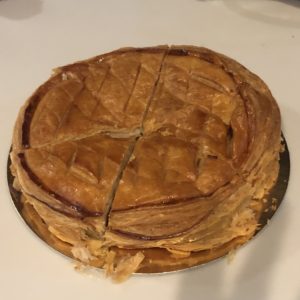
Galette des Rois – literal translation is Kings’ Cake and is defiantly one of my most favorite things. It has been for years, since my discovery in January of 1993.
My husband and I landed in Paris on January 2, 1993 after our wedding on New Years Eve, 1992. Paris was the European entry point which kicked off our three week honeymoon. We traveled through Detroit and arrived in Paris early on a Saturday morning. The blue skies and sun were welcoming yet deceiving as it was ice cold and ended up being one of the coldest winters in Paris.
We collected our bags and finely figured out where to queue for a taxi to take us to the Welcome Hotel. You must understand that my search for the perfect hotel was painstaking, mind you this was before Google or any other convenient web search tool coupled with not knowing the translation of what the $$ symbols actually meant, especially in Paris. After much research, I found the Welcome Hotel in a guide for women traveling in Paris alone. Perhaps that should have been a red flag and perhaps a guide for honeymooners would have been more apropos? Or was it fate that this was the chosen place for our very first stay in Paris?
The Welcome Hotel was the farthest from the extravagant honeymoon hotel that I had envisioned. It was inexpensive for Paris standards, was minimal though very clean, and included a traditional French breakfast of strong coffee, croissants, and baguettes with butter that is like any other in the world. Conveniently, it was delivered daily to the tiniest room that I have ever stayed in, even to this day.
The breakfast was definately a highlight, but the best amenity by far was location, location, location. The hotel was situated in Paris’s 6th Arrondissement – St. Germain des Pres – one of my favorites, and after 26+ years, the Welcome Hotel is still operating there today.
I credit The Welcome Hotel for my initial discovery of Galette Des Rois. The only window in our room over looked the Rue de Seine and was almost directly above the small walk-up pâtisserie on the sidewalk below. It was there that my instantaneous love affair with Galette Des Rois began.
Upon the first encounter and every one after during our honeymoon adventure, we had no idea that this indulgence was in fact Galette Des Rois. Every place we went in Paris and other parts of France we asked for and called it Galette Amande, which was the name we were given at that first fateful pâtisserie near the Welcome Hotel.
Not knowing anything about this galette except that it was highly addictive, we sought it out for breakfast with strong coffee ignoring the stares from the locals, for an afternoon treat with champagne, for a late night snack. It was a delicious reason to escape the freezing temperatures and enjoy the comfort of a warm, cozy pâtisserie and the comfort if my new found love. It’s no wonder that I came home with an additional 10+ pounds and jeans that no longer fit. It would be years latter that we would learn from a French friend that Galette Amande was in reality Galette Des Rois followed by the history including of course why it is only available in January.
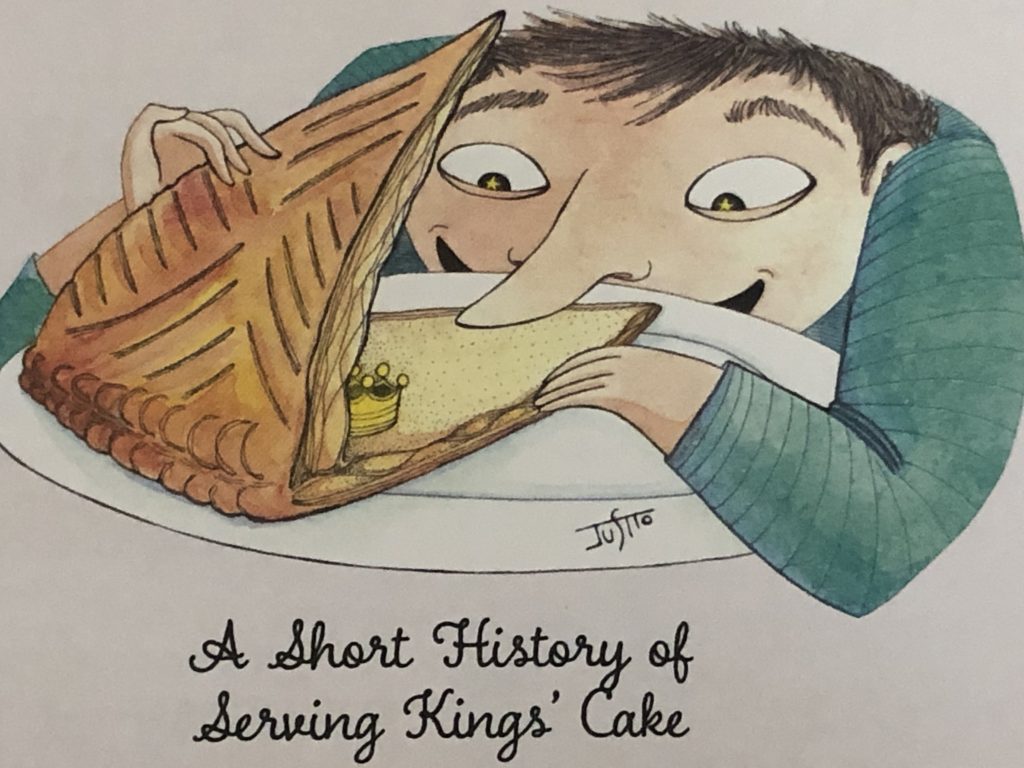
- French culinary tradition dating back to the 14th Century. Learn more about the history of and recipe for Galette Des Rois in Let’s Eat France! on pages 360 and 361.
- Celebration of Epiphany on the first Sunday of the New Year, on or around January 6th.
- Acknowledges the appearance of the Three Wise Men who came bearing gifts for the Baby Jesus.
- Available only during the month of January, during the Epiphany season.
 Tradition includes a little trinket or fêve – usually ceramic – that is hidden inside the cake. The person that finds the fêve in their slice is crowned King and keeps the ceramic surprise.
- No two Galette Des Rois are the same. They vary not only by pâtisserie but also by region in France.
Enjoying galette des rois (kings’ cake) during the month of January to mark the Epiphany is one of the most vivacious pastry traditions in France. Every year, French pastry chefs compete based on know-how, creativity and…on cost margin! Exclaims Francois-Régis Goudry, French Food Critic, Food Show Host, Journalist, and Author of one of my favorite books Let’s Eat FRANCE!
Do It In Paris post of January 4th features Les 10 Meilleurs Galette Des Rois – the 10 best for 2019. One of which I discovered January 2018 and is on the top of my favorite list. It is the most wonderful creation by Maison De La Truffe, orgasmic in fact! Marrying a traditional recipe with truffles, truly a Galette of my dreams !
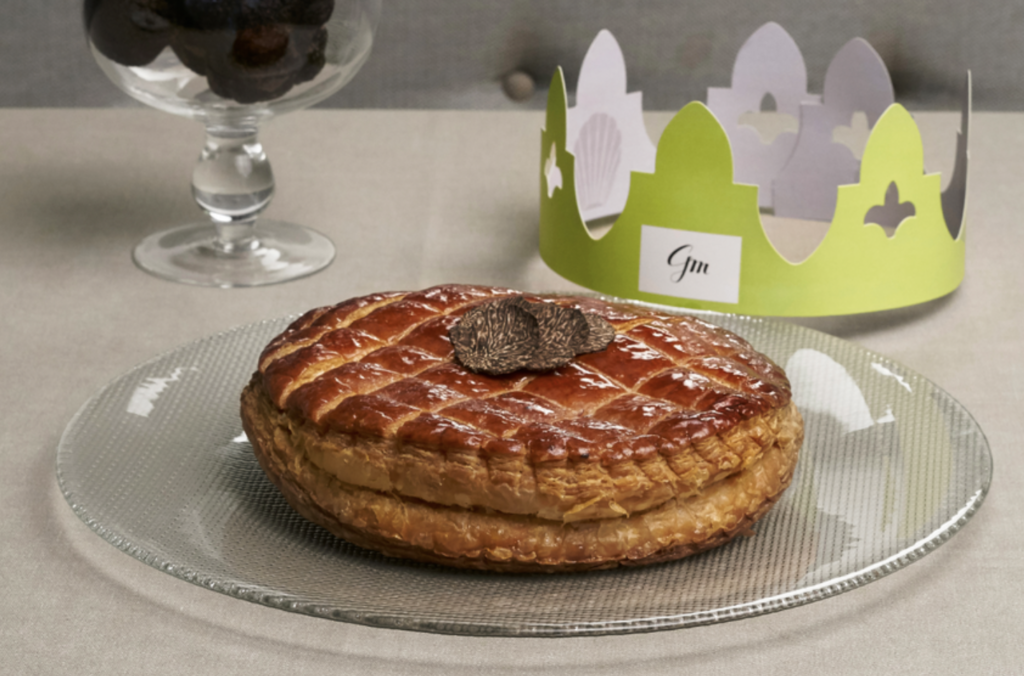
We special ordered this pastry made from almond powder, crushed hazelnuts and black melanosporum truffles and picked up this freshly baked treasure for one last indulgence during the Air France flight back to San Francisco. Enjoying it with champagne, it prolonged our French epicurean fête and was a nice conclusion of our 25th Wedding anniversary celebration, the reason that we were in Paris.
An article from The Local – Galette de Rois: All you need to know about the French tart for kings, cements Goudry’s statement Every year, French pastry chefs compete based on know-how, creativity…Two of the most creative that I’d like to experience someday include the following:
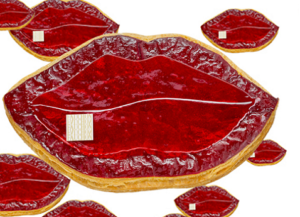
The prestigious pâtisserie Fauchon has created a cake in the shape of lips – or Bouche in French.
Richard Legay, the famous baker from Legay Choc in the 4th Arrondissement – The Marais has done something more risqué – a galette in the shape of a male apendage that includes mini matching ceramic renditions as the ceramic prize.
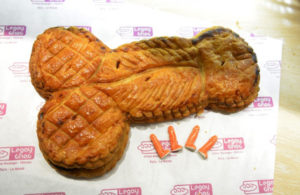
Both creative examples of the transformation and modernization of this old tradition are probably not what was ever originally intended and probably not appropriate for the celebration of the Epiphany.
With said, both could be very apropos for a January wedding shower or bachelor/bachelorette party. Such new creative interpretations makes my mouth water and ignites a strong desire to not only visit Paris and all of France to seek out other ‘interpretations with a twist’ but also to learn the art of making directly from an expert – a true French pâtissier. A January 2020 foray to France might be inevitable.

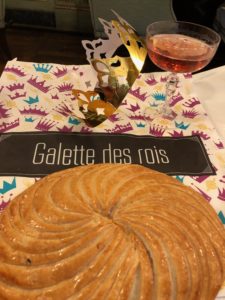
For now, Fleur de Cocoa in Los Gatos is the best resource to satiate my burning desire for Galette Des Rois in the San Francisco Bay Area during the month of January. I strongly suggest that you order in advance as there is no guarantee that they will have inventory available if you just stop by, especially during the weekend. For convenience, you can even order on-line. I also would also highly recommend buying several and freezing for those days when the desire is excruciating. Freezing is not quite the same as fresh, but close enough to fill the void until the next January arrives.
Thanks to that fateful stay at the Welcome Hotel coupled with the record low temperatures of Paris, I found Galette Des Rois, one of my favorite things.
A tradition,
A treasure,
A favorite forever,
Je t’aime Galette Des Rois!
Bon appétit!

Featured image above is a photo of the menu from La Restaurant | Garance in Paris taken by xo Sandrella.
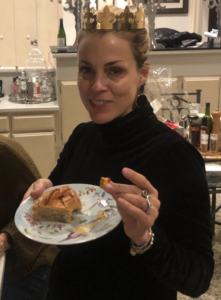
What a story! You never know where you lose or what you find! Sandra, your fateful stay at Welcome hotel found you Gallete des Rois – a century’s old tradition , that became your family tradition. John and I stopped at your place all of a sudden, and we’re blessed with breaking up with you your 2019 Gallete des Rois. I didn’t get “the feve”, you were the Queen of the day. But I got my epiphany moment. Gallete des Rois! Thank you!!!
Delightful! And to think how it began is a great story, come full circle with your 25th!
Your previous post about listing your favorite things for 2019 was most inspiring to me….lessons in how to keep ones glass full!
Ha.. I was transported, at least in spirit, Sandrella!
Next time I am there, or ( indeed) Los Gatos, in January…
Keep the beautiful images coming..!
Nice story. You have a flare for the background narrative.
Many years ago, I learned of a very similar culinary tradition in Mexico. This is not surprising in light of the common religious origins with Catholicism in both France and Mexico. In the case of Mexico, the bread is known as “Rosca de Reyes” – the King’s wreath. Below is the summary of the Mexican tradition – shameless appropriated from its author.
“Rosca de Reyes is a sweet bread, which is a special food for Three King’s Day, known as “Día de Reyes” in Spanish, and celebrated on January 6 in Mexico. The holiday is sometimes referred to as the Twelfth Night because it falls twelve days after Christmas, but is also known as Epiphany, and marks the day the Wise Men or Magi, Melchor, Gaspar and Baltazar, are believed to have visited the Christ Child. On this day, Mexican children receive gifts from the three kings, sometimes placed in shoes that the children have left out overnight and placed in hay as a gift of food for the kings’ animals.
“Rosca” means wreath and “Reyes” means kings, so a direct translation of Rosca de Reyes would be “Kings’ Wreath”. The sweet bread is shaped in the form of a wreath and usually has candied fruit on top, and a figurine of a baby baked inside (now made of plastic but previously they were porcelain or tin). This special treat is often simply called “Rosca.” The traditions surrounding this sweet bread is similar to the custom of eating King Cake in New Orleans during Carnival season.
In Mexico, it is customary for friends and family to get together on January 6 to eat Rosca, usually accompanied by hot chocolate or another warm drink such as coffee or atole. Usually, each person cuts their own slice and the one who gets a piece of Rosca with the baby figurine is expected to host a party on Día de la Candelaria (Candlemas), which is celebrated on February 2nd. On that day, the traditional food is tamales. Nowadays bakers tend to put several baby figurines in the Rosca, so the responsibility for making (or buying) the tamales can be shared among several people.
The symbolism of the Rosca de Reyes speaks of the Biblical story of Mary and Joseph’s flight to Egypt to protect the infant Jesus from the slaughter of the innocents. The shape of the Rosca symbolizes a crown, in this case, the crown of King Herod from whom they were trying to hide the infant Jesus. The dried fruit placed on top are jewels on the crown. The figurine in the Rosca represents baby Jesus in hiding. The person who finds the baby Jesus is symbolically his godparent and must sponsor the party when he is taken to the temple to be blessed, celebrated as Día de la Candelaria, or Candlemas, on February 2nd.”